Explodable 3D Dog Skull for Veterinary Education
3D models of teeth and neurovascular system in the rostrum of Spinosauridae (theropod dinosaurs)
3D models of Bartassochersis lopezi
3D GM dataset of bird skeletal variation
Skeletal embryonic development in the catshark
Bony connexions of the petrosal bone of extant hippos
bony labyrinth (14) , Eocene (11) , inner ear (11) , CT-scan (10) , geometric morphometrics (10) , Miocene (9) , Oligocene (9)
Lionel Hautier (25) , Maëva Judith Orliac (24) , Laurent Marivaux (20) , Bastien Mennecart (16) , Renaud Lebrun (15) , Rodolphe Tabuce (15) , Pierre-Olivier Antoine (13)
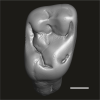
left maxillary fragment preserving P4 and M1–3
Data citation:
Romain Weppe , Charles Leriche, Mohd Waqas
, Rajendra Rana
, Ashok Sahni and Thierry Smith
, 2026. M3#1950. doi: 10.18563/m3.sf.1950
Model solid/transparent
Download 3D model|
|
3D models related to the publication: A new, tiny dichobunoid artiodactyl from the Eocene of India revisits the lower body size limit in artiodactylsRomain Weppe, Charles Leriche, Mohd Waqas, Rajendra Rana, Ashok Sahni and Thierry SmithPublished online: 14/10/2026Keywords: Body mass; Dispersal corridors; Mammals; Phylogeny; Subathu Formation https://doi.org/10.18563/journal.m3.312 Abstract This 3D dataset contains the 3D models of the fossil specimens of Lilliputia gujjarorum, a new tiny dichobunoid artiodactyl from the early middle Eocene of northwestern India. The material includes the holotype, GU/RJ/003 (Rajouri Collection, H.N.B. Garhwal University), consisting of an associated left mandible fragment preserving the distal part of p4 and m1–3 (GU/RJ/003a) and a left maxillary fragment preserving P4 and M1–3 (GU/RJ/003b), as well as the referred specimen GU/RJ/005, a right mandible fragment preserving m1–2. The exceptionally small body size of Lilliputia, among the smallest known in Artiodactyla, together with its mosaic of primitive and derived dental characters, provides new insights into the early evolution, palaeobiogeography, and ecological diversification of artiodactyls during the Eocene. M3 article infos Article state: in_press |
|